



 By
·
8 minute read
By
·
8 minute read
The spikes in “Where is my order?” do not originate in the contact centre; they are the result of a post-purchase experience with limited visibility, unreliable delivery estimates and still largely manual processes. When customers cannot clearly see the delivery status, they contact the company to reduce uncertainty.
The ticket is therefore only the thermometer of an operational fever. In many organisations, reducing inbound contacts is not an explicit priority, even though volumes are expected to grow. McKinsey notes that only 11% of customer care leaders state “reducing volume” as a priority, while 57% expect an increase in calls over the next 12–24 months. This makes it urgent to move prevention upstream of support.
ShippyPro was created precisely to act before the ticket appears: it centralises tracking and notifications, validates addresses, and provides analytics on carrier performance. The goal is not simply to “respond faster”, but to prevent the customer from having to ask in the first place.
We show how to automate these levers with ShippyPro – Tracking, Notification, Address Validation and Optimizer – to filter WISMO and anomalies, reduce repetitive contacts and improve collaboration between operations, carriers and customer care. An end-to-end approach that delivers measurable impact on operating costs, SLAs and NPS.
Why customers open shipping-related tickets
The recurring reasons cluster in five key areas, all linked to a systemic lack of visibility, communication or control over post-purchase processes. Understanding them means identifying the root causes of tickets and pinpointing operational and technological levers that can structurally reduce volume.
Lack of visibility on order status
Lack of visibility on tracking is one of the main drivers of customer care tickets. Consumers actively follow their deliveries and expect accurate, timely and easily accessible information. When updates are incomplete, fragmented or unclear, perceived uncertainty increases and customers seek reassurance from support.
It is not just about “showing where the parcel is”, but about providing context: the estimated delivery date, expected milestones, any deviations and what the customer can do if something goes wrong. A centralised view, updated in real time and aligned with the brand, offers the customer a reliable single source of truth and drastically reduces the need to get in touch, especially at critical points in the delivery journey.
Delays not communicated – or poorly communicated
Shipping delays are part of everyday operations, but how they are communicated determines their impact on customer care.
When a delay is not anticipated by a clear, complete and action-oriented notification, the customer perceives the company as unprepared or disorganised. Communication should instead provide an understandable picture: the reason for the delay, a new reliable estimate, any options available and what is expected from the customer, if anything.
Best practice shows that proactive messages designed with “closure” logic (i.e. they leave no open questions) can prevent most incoming requests. Conversely, generic or late notifications create frustration and drive extra traffic towards support, especially during peak shipping periods.
Address errors
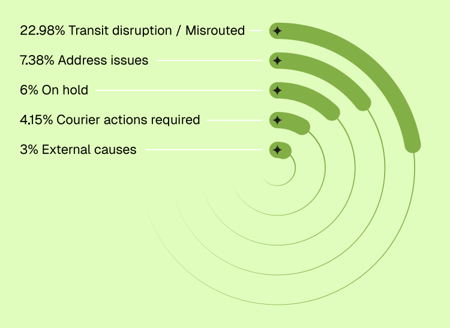
Address errors are one of the main causes of failed deliveries, unnecessary returns and parcels held in storage, with both economic and operational impacts. In many cases, the problem arises well before shipping, at checkout, where input fields do not properly guide the user or lack robust data quality checks.
An incorrect address triggers a long chain of inefficiencies: failed delivery attempts, carrier contacts, clarification requests, customer care tickets and, in the worst cases, automatic returns. Preventive validation — via APIs that verify and standardise data in real time — dramatically reduces these exceptions.
For brands with significant volumes, the impact translates into lower costs, higher delivery rates and less pressure on support, as well as a smoother and more predictable customer experience.
Carrier exceptions (failed delivery, storage, loss)
Delivery exceptions are inevitable, but they only turn into tickets when there are no processes designed to detect and manage them promptly.
Events such as failed attempts, parcels in storage or lost shipments require an “exception-first” approach: capturing the status in real time, classifying the event, informing the customer and clearly indicating which actions they can take. When, instead, the company leaves the customer “waiting for updates”, frustration grows and support becomes the only reference point.
The most mature organisations integrate guided notifications, self-service options and interactive portals that allow customers to edit addresses, choose pick-up points or schedule a new attempt. This approach not only reduces tickets, but also increases internal efficiency and improves perceived operational reliability.
Issues with returns and refunds
Returns management is often one of the most sensitive parts of the post-purchase journey. Unclear timelines, poorly visible instructions or lack of updates generate uncertainty and push customers to request information repeatedly.
Companies that do not structure a transparent process quickly become overwhelmed by tickets related to the status of the return, parcel checks or refund processing times. Implementing intuitive returns portals with codified policies, dedicated tracking and step-by-step notifications reduces the load on customer care and improves the overall customer experience.
Strategies to reduce shipping-related customer care tickets
Reducing tickets means addressing the root causes, automating repetitive responses and giving customers clear, self-service tools. These are the key levers.
Proactive tracking and smart notifications
Sending “an email when the parcel ships” is not enough. You need a sequence of relevant updates at each stage, using the right channel for the right message. SMS notifications are particularly effective for urgent situations and can prevent parcels being held in storage or failed delivery attempts; email alone often has lower open and engagement rates.
With ShippyPro, you can configure event-based triggers (e.g. exception, failed attempt, out for delivery) and use personalised templates that close the customer action within the message itself, leaving less room for uncertainty.
Branded tracking page
The tracking page must be the brand’s “official source” of information, not just a redirect to the carrier website. Proprietary tracking, consistent with your visual identity and copy, reduces WISMO and builds trust.
Three essential elements of tracking pages:
- Real-time status and an estimated delivery date within a credible time window
- Quick actions: address change, PUDO selection, permission to leave in a “safe place”
- Alternative help channels only when necessary (to avoid over-exposing support)
Preventive address validation
Validating the address at checkout eliminates errors before they enter the warehouse and delivery flows. ShippyPro’s Address Validation APIs enable automatic checks in over 240 countries, preventing storage and return costs and flagging missing house numbers or postcodes.
Market studies show significant reductions in failed deliveries thanks to real-time address verification; some reports indicate drops of up to 64–70% in specific contexts. Use these benchmarks as a starting point and test them against your product-market mix.
Forecasting and managing exceptions
Design an “exception-first” flow: capture the event scan, classify the exception, inform the customer with clear instructions and unlock self-service options. An order portal that allows customers to correct the address, choose a pick-up point or schedule a new attempt avoids a large share of incoming contacts.
Operational tip: send notifications only when they add value and close the required action. Generic communications increase questions instead of reducing them.
Analysing carrier performance
A share of tickets is generated by sub-optimal carrier choices for specific zones, seasons or product categories. Shipping intelligence solutions make it possible to track average transit times, on-time performance and costs by carrier and country, enabling rapid adjustments to SLAs and routing.
A scoring model that balances cost, SLA and regional suitability supports robust choices aligned with your strategy. Experience shows that cheaper carriers with inconsistent on-time performance generate more complaints, refunds and internal costs: it is better to balance price and reliability.
Dynamic FAQs and support automation
Self-service does not remove the human touch; it preserves it for the cases that matter most. A knowledge base linked to order status reduces first-level contacts; virtual agents can handle WISMO, standard returns and recurring requests. Some integrations report automation of 40–50% of calls, including WISMO.
From a cost perspective, remember the gap between assisted channels and self-service: optimising “deflection” delivers fast, measurable returns.
How to measure the effectiveness of your strategies
Every initiative should be measured against a small set of clear, shared KPIs. Define a 4–6 week baseline, then monitor trends and cohorts by channel, country and carrier. Bring together shipping data and contact centre logs into a single view.
Recommended post-shipping KPIs:
- Contact rate per order and the share of WISMO on total contacts
- Tickets per 100 orders and “deflection rate” to self-service
- First-attempt delivery rate and average transit time per carrier
- Post-delivery NPS and time-to-first-response on remaining cases
ShippyPro Optimizer provides dashboards on performance, costs and returns, helping you connect routing decisions to changes in ticket volume and customer satisfaction. Combining these insights with contact costs enables clear business cases for preventive investments.
How PhotoSì eliminated hidden costs and improved NPS through shipping automation
 PhotoSì, one of the leading Italian players in personalised photo printing, managed over one million shipments per year in-house, coordinating three carriers with manual processes and growing operational complexity. This approach led to inefficiencies in order management, frequent delivery errors and a significant volume of customer care requests.
Thanks to ShippyPro, PhotoSì was able to automate its entire logistics flow: unified tracking, automated notifications, address validation at checkout, simplified integrations with multiple carriers and an analytics layer to monitor performance and anomalies. The results were tangible: a 20% reduction in support requests, a 30% saving in operational working hours and a 40% decrease in costs linked to integration and logistics management.

This case clearly demonstrates how an approach based on technology, transparency and optimised flows can transform the customer experience and make the entire supply chain more efficient. Proprietary tracking, validated addresses and operational visibility become true “preventive filters”, able to intercept issues before they turn into tickets.
Want to explore the full case study? Visit: shippypro.com/en/photosi
Conclusion
Reducing customer care tickets related to shipping means eliminating the causes before they surface. Clear visibility, communications that close the loop and data-driven carrier selection are the foundation. Automating what is repetitive frees agents to focus on high-impact cases.
Three practical takeaways:
- Design your tracking page as a product, not as a simple link.
- Validate addresses at checkout and open self-service options for exceptions.
- Measure contact rate, WISMO% and first-attempt delivery every week, adjusting quickly on carriers and flows.
ShippyPro can enable all these moves without turning them into an endless IT project: Tracking and Notification to reduce WISMO, Address Validation to prevent errors, Optimizer to select the right partners and prove ROI. Discover how to apply them in your own context and where they can have the greatest impact.
Delivery exceptions and customer service: keep reading
FAQ on shipping and customer care tickets
Why do we receive so many “Where is my order?” tickets?
Spikes in “Where is my order?” requests do not depend solely on the contact centre, but on a post-purchase experience that lacks transparency. If customers do not have access to a clear order status, with up-to-date delivery times and guidance on what to expect, their only way to reduce uncertainty is to contact the company. In practice, the ticket is a symptom of missing visibility and coordination between logistics, carriers and tracking systems, not the root problem.
What are the main causes of shipping-related tickets?
The most frequent causes fall into a few recurring areas: insufficient visibility on order status, delays that are not communicated or are communicated ambiguously, errors in delivery addresses, unmanaged delivery exceptions (such as storage or failed attempts) and unclear processes for returns and refunds. All of these stem from fragmented processes and communications that are not designed end-to-end, forcing the customer to use customer care as an information hub.
How can I reduce shipping-related tickets without harming the customer experience?
The key is to intervene before the ticket is created, working on prevention and automation. This means designing proactive tracking with notifications focused on critical milestones, providing a proprietary tracking page as a single source of truth, validating addresses at checkout to avoid downstream errors and managing exceptions through self-service portals. In this way, the company reduces repetitive contacts and frees customer care to focus on high-impact cases, while also improving brand perception.
Why do tracking pages and address validation have such a strong impact on ticket volume?
A well-designed tracking page makes the brand the official source of delivery information, preventing customers from having to search elsewhere or call support. When combined with automatic address validation at checkout, it prevents many of the root causes of failed delivery, storage and unnecessary returns. Together, these elements reduce operational errors, cut costs and lower the likelihood that the customer will open a ticket just to understand what is happening with their order.
How does ShippyPro help reduce tickets, operational costs and WISMO?
ShippyPro tackles issues at their source: it centralises carrier tracking, automates notifications, validates addresses and provides analytics on shipping performance. This makes it possible to filter WISMO cases and exceptions before they reach customer care, select the most suitable carriers by zone and product, and measure the impact of initiatives on costs, SLAs and NPS. The result is a more predictable operating model, with fewer repetitive contacts and a more consistent customer experience across all post-purchase touchpoints.

Curious by nature, analytical by mindset, Giulia Castagna is the voice behind ShippyPro’s content. As Content Marketing Manager, she simplifies complex logistics topics for those who ship around the world every day. She writes about AI, automation, and shipping trends to inspire data-driven decisions.