



 By
·
12 minute read
By
·
12 minute read
A customer emails you: "My order still hasn't arrived." You check the tracking page and it says "In Transit" and has for four days. Sound familiar? Lost parcels are one of the most costly and time-consuming problems in e-commerce operations. Beyond the financial hit of reshipping or refunding, every unresolved case chips away at customer trust and inflates your support queue. This guide walks you through exactly what to do when a parcel goes missing: how to investigate it, how to communicate with the customer, how to file a carrier claim and how to prevent it from happening as often in the future — using real-time shipment tracking and smarter workflows.

🗝 Key Takeaways
- Wait before acting: Most "lost" parcels are simply delayed. A standard waiting window (48–72 hours after the expected delivery date) prevents unnecessary claims and reshipping.
- Investigate before contacting the carrier: Check the full tracking history, confirm the shipping address and rule out misdelivery before opening a formal trace request.
- File carrier claims within the deadline: Most carriers require claims within 30–60 days of the ship date. Missing that window means losing your reimbursement right.
- Your response speed is your brand: Customers who receive a proactive update about a delayed shipment are significantly less likely to escalate to a chargeback than those left in the dark.
- Prevention beats resolution: Automated tracking notifications and multi-carrier visibility reduce WISMO tickets before they start, cutting the volume of lost-parcel cases you have to handle.
📋 In this article
- Why Parcels Go Missing
- Is It Actually Lost? How to Investigate First
- How to File a Carrier Claim Step by Step
- Carrier Claim Deadlines and Coverage
- How to Communicate with Your Customer
- Reshipment or Refund: Which to Offer
- Preventing Lost Parcels with Better Tracking
- Lost vs. Stolen: A Different Problem
Why Parcels Go Missing
Before you can fix the problem, it helps to know where it originates. Lost parcels rarely just vanish, there is almost always a root cause. Understanding the most common ones lets you respond faster and spot patterns in your own shipment data.
Carrier sorting errors
High-volume carrier hubs process millions of packages a day. Misread barcodes, label damage, or packages falling off conveyor belts can send a parcel to the wrong regional depot. The tracking system may stop updating entirely, or show a scan in a location that makes no geographic sense.
Incorrect or illegible address labels
A transposed postcode, a missing apartment number, or a label that got wet in transit can all cause misdelivery or return-to-sender events that look identical to a lost parcel in the tracking feed. This is one of the most preventable causes: automated label generation pulls address data directly from your order management system, eliminating manual transcription errors.
Theft (porch piracy)
Package theft is a growing problem, particularly for high-value consumer goods. In these cases, the carrier tracking will show "Delivered" — but the customer never received the order. This scenario requires a different response from a genuinely lost parcel, which we cover in the Lost vs. Stolen section below.
Customs delays or seizures
For international shipments, packages can be held indefinitely at customs if documentation is incomplete, if duties are unpaid, or if the shipment contains a restricted item. The tracking status in these cases is often ambiguous and may not update for days. Merchants shipping cross-border should consult official customs guidance and ensure commercial invoices and HS codes are accurate on every international label.
Warehouse mis-picks and scan gaps
Sometimes the package never actually left your warehouse. A mis-pick, a forgotten scan at collection, or a missed carrier pickup all create "lost" tickets from the customer's perspective even though the issue is internal. Real-time carrier scan data in your tracking dashboard lets you see exactly where in the chain the trail goes cold.
Is It Actually Lost? How to Investigate First
Not every delayed parcel is a lost parcel. Before you open a carrier claim or offer a refund, run through this investigation checklist. Acting too early costs you money; acting too late costs you the customer.
Reshipping immediately upon a customer complaint, before confirming the original parcel is truly lost, is one of the most common and expensive mistakes in e-commerce operations. Carriers define a parcel as "lost" only after a defined waiting period (usually 7–15 business days from the last scan). Filing a claim or sending a replacement before that window closes can result in the original parcel arriving after the replacement, leading to a double-delivery with no recourse for cost recovery.
Step 1: Check the full tracking history
Do not just look at the status summary. Pull the full scan-by-scan event history. Look for the last known location, the time since the last scan, and any exception events (e.g. "address not found", "refused by recipient", "attempted delivery"). Multi-carrier ecommerce order tracking surfaces all of this in one view rather than logging into each carrier portal separately.
Step 2: Verify the delivery address
Cross-check the shipping address on the label against the original order. Look specifically for missing unit or apartment numbers, incorrect postcodes, and common transcription errors. If the address is wrong, the parcel may have been returned to sender, check if there is a return-to-origin scan in the tracking history.
Step 3: Ask the customer to check locally
Before escalating, ask the customer to check with neighbours, building concierges, and any safe-drop locations (sheds, garages, behind plant pots). Carriers sometimes leave parcels in unexpected spots and mark them as delivered. Also ask whether anyone else at the address might have accepted it.
Step 4: Wait the carrier's "lost" window
Each carrier defines how long they need before they will accept a lost parcel trace request. This is typically 5–15 business days after the expected delivery date. Waiting this period is not just a carrier policy requirement — it is the window within which the majority of "missing" parcels actually resurface.
Pull the complete scan history, not just the summary status. Identify the last known scan location and any exception events.
Compare the label address against the original order data. Check for missing apartment numbers, wrong postcodes, or typos.
Request they check with neighbours, building staff, and any safe-drop locations before assuming non-delivery.
Respect the carrier's minimum waiting period (typically 5–15 business days after expected delivery) before opening a formal claim.
If the parcel has not surfaced after the waiting period, contact the carrier to open a formal trace or lost parcel investigation.
How to File a Carrier Claim Step by Step
Once you have confirmed the parcel is lost, you need to file a formal claim to recover costs. The process varies by carrier, but the structure is the same across all of them. Having your documentation ready before you start significantly speeds up resolution.
What you will need
Carriers require specific documentation to process a lost parcel claim. Gather the following before you start:
- The tracking number and proof of postage (carrier receipt or dispatch confirmation)
- Proof of the item's value (invoice, purchase order, or product listing with price)
- Proof of shipment contents (packing slip or order confirmation)
- The customer's delivery address as it appeared on the label
- Any written confirmation from the customer that the parcel was not received
Where to file
Most major carriers accept claims through their online portal. You do not need to call. Key portals:
| Carrier | Where to file | Time to resolution |
|---|---|---|
| DHL Express | dhl.com — My DHL Portal, "Claims" section | Initial update within ~3 business days; full resolution varies |
| FedEx | fedex.com — "File a Claim" tool | Up to 20 business days |
| UPS | ups.com — "Claims Center" | 5–10 business days once documentation is complete |
| Royal Mail (UK) | royalmail.com — "Claims" form | Up to 30 calendar days |
| Evri (UK) | evri.com — "Help" section, lost parcel form | Up to 30 days |
| DPD | dpd.com — Customer portal claims section | 10–15 business days |
Carrier Claim Deadlines and Coverage
Missing a claim deadline means losing your right to reimbursement entirely. These deadlines are strictly enforced. The table below covers the most common carriers used by e-commerce merchants shipping globally.
| Carrier | Claim deadline (from ship date) | Standard coverage (domestic) | Notes |
|---|---|---|---|
| DHL Express | 30 days | Up to €100 / shipment (standard) | Additional declared value available at booking |
| FedEx | 60 days (damaged/missing contents, domestic); 9 months (lost/undelivered shipments); 21 days (international) | Up to $100 / shipment (standard) | Declared value up to $50,000 with fee. Use the correct claim type — filing damaged vs lost affects your deadline |
| UPS | 60 days (domestic); 21 days (international) | Up to $100 / shipment | UPS Capital insurance available separately |
| Royal Mail (UK) | 30 days from eligible claim date (Tracked 24/48); 80 days for standard 1st/2nd Class retail | 1st/2nd Class: up to £20. Tracked 24/48: up to £100. Special Delivery: up to £750 | Claim window for Tracked services updated August 2025. Minimum wait: 7 working days after due delivery date before filing |
| Evri (UK) | 28 days from expected delivery | Up to £20 (standard) | Enhanced cover available at booking |
| DPD | 28 days from expected delivery | Varies by contract | Check your account terms for specific limits |
Standard carrier liability caps are low — as little as £20 for Royal Mail standard services or $100 for FedEx and UPS. If you ship high-value goods without declaring value or purchasing additional cover at booking, you will only recover a fraction of the item cost in the event of a loss. Always review your carrier contract and consider adding declared value cover for orders above the standard threshold.
Keep a running spreadsheet of every lost parcel claim: carrier, tracking number, ship date, claim date, outcome, and amount recovered. Over 3–6 months, this data will show you which carriers have the highest loss rates on which routes, letting you make evidence-based decisions when you review carrier performance and cost data for future shipments.
How to Communicate with Your Customer
How you handle the customer communication during a lost parcel incident is often more important than the resolution itself. Customers do not expect perfection, they expect honesty, speed, and to be kept in the loop. Getting this right is the difference between a one-star review and a repeat buyer.
The first response: acknowledge immediately
When a customer contacts you about a missing order, respond within a few hours. The first message does not need to resolve the issue but it needs to confirm you have seen it, that you are investigating, and that you will update them by a specific time. Vague responses ("we'll look into it") erode trust faster than the delay itself.
"We have passed this to our courier and are waiting to hear back. This may take a few days." No timeline, no ownership, no next step — leaves the customer feeling ignored.
"Hi [name], thanks for getting in touch. I can see your order hasn't updated since [date] and I'm investigating now. I'll come back to you by [specific time] with a clear next step." Specific, accountable, and human.
Proactive notifications cut WISMO tickets
A large proportion of lost-parcel support tickets arrive because customers never received proactive updates when their shipment stopped moving. Automated shipping notifications that trigger on exception events — "Your shipment has been delayed" — tell the customer before they have to ask, which significantly reduces inbound WISMO (Where Is My Order) volume. Brands using proactive exception alerts consistently report meaningful reductions in shipping-related support contact volume.
Be clear about what happens next
Customers need to know: are you reshipping? Refunding? Waiting for the carrier investigation? Tell them explicitly, and give a timeline. If the carrier investigation will take 15 business days, say so — and set a follow-up in your support tool to update them before that deadline, not after.
Reshipment or Refund: Which to Offer
There is no universal rule here. The right resolution depends on the item, the customer's situation and your margin on the order. Here is a framework that most merchants find workable.
When to reship
Reshipping is the better option when: the item is still in stock and the gross margin can absorb the extra shipping cost, the customer's address has been verified as correct, and the original parcel has been confirmed lost by the carrier (not just delayed). Reshipping without address verification is one of the most common causes of double-loss events.
When to refund
Refund when: the item is out of stock, the customer explicitly requests it, the order value is high enough that reshipping doubles your exposure before the carrier claim is settled, or the customer needs the item urgently and cannot wait for a reshipment timeline.
The offer that builds loyalty
For mid-value orders (roughly £30–£100 / $35–$120), consider offering the customer a choice: reship with expedited delivery, or a full refund plus a discount code for a future order. Giving the customer agency in the resolution converts a frustrating experience into a positive one, and the discount code has a high redemption rate — partially recovering the loss through future revenue. Pair this with a smooth returns and reshipment workflow so the new order ships without additional friction.
Preventing Lost Parcels with Better Tracking
No process fully eliminates lost parcels, but you can significantly reduce their frequency and their cost with better visibility and automation. The most impactful lever is moving from reactive to proactive: knowing a shipment has stalled before the customer does.
Real-time multi-carrier tracking
If you use more than one carrier (and most growing e-commerce businesses do), managing tracking across separate carrier portals is slow and error-prone. Centralised shipment tracking that aggregates scan events from all your carriers in one dashboard means anomalies — stalled shipments, missing scans, exception events — are visible immediately, not hours later when a customer has already emailed you.
Automated exception alerts
Set up automation rules that trigger an internal alert (to your ops team or support inbox) the moment a shipment goes more than 24 hours without a scan update past its expected in-transit timeline. This gives you a head start on investigating before the customer contacts you. ShippyPro's Automation lets you build workflows with exception-based triggers that escalate stalled shipments automatically — no manual monitoring required.
Address validation at checkout
A significant share of lost parcels trace back to bad address data submitted at checkout. Address validation tools that check postcode-to-street-name consistency and flag undeliverable addresses before the order is placed catch the problem at the cheapest possible point in the process.
Carrier performance monitoring
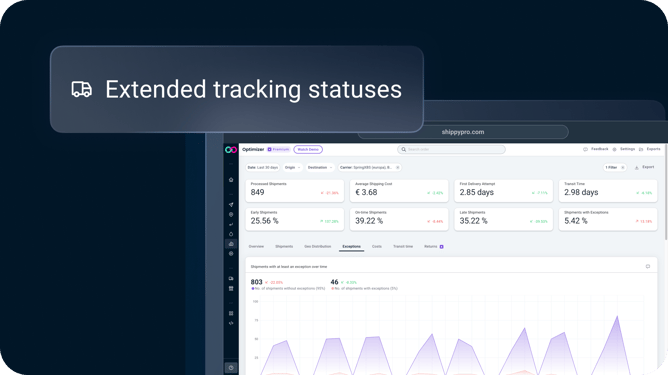
Use your shipment data to track loss and damage rates by carrier and by route. Some carriers perform significantly worse on specific origin-to-destination lanes. If your data shows a pattern — say, a carrier with a 3% loss rate on certain international routes — you have the evidence to switch volume to a better-performing option. ShippyPro Optimizer gives you geo-localised carrier performance analytics and cost breakdowns to support exactly this kind of decision. The Invoice Analysis tool can also surface discrepancies between carrier billing and actual service delivery, which sometimes correlates with operational quality issues.
Lost vs. Stolen: A Different Problem
When a parcel shows "Delivered" but the customer says they never received it, the situation is fundamentally different from a lost parcel. The carrier has documented proof of delivery. The customer is either the victim of porch theft, or, in a small percentage of cases, making a fraudulent claim.
How to handle a "delivered but not received" claim
First, ask the carrier for the proof of delivery record. Most carriers can provide a GPS coordinate or photo of where the parcel was left. Share this with the customer — it often jogs their memory (a parcel left with a neighbour, behind a bin, in a communal hallway).
If the proof of delivery shows the correct address and the customer still maintains they did not receive it, assess the order history. A first-time customer making a high-value claim with no previous orders warrants more scrutiny than a customer who has ordered ten times. For high-value items, consider requiring a signature-on-delivery service for future orders to the same address.
What the EU and UK say about merchant liability
Under Article 20 of EU Consumer Rights Directive 2011/83/EU, the risk of loss stays with the merchant until the consumer (or a third party they designate) physically receives the goods — not simply when the carrier records a delivery scan. The only exception is when the consumer themselves arranged the carrier and that option was not offered by the merchant. This means that a carrier's "Delivered" scan does not automatically end your liability under EU consumer law. In practice, most merchants absorb lower-value losses to preserve the customer relationship and reserve formal disputes for high-value claims with clear fraud indicators.
Keep a record of customers who file repeated "delivered but not received" claims. A customer with two or more such claims in a 12-month period should have future orders flagged for signature-required delivery or manual review before dispatch. Your order management workflow can automate this flag using order tags.
Track & Trace
Real-time shipment tracking across all your carriers in one dashboard. Catch stalled shipments before your customers do.
Explore Track & Trace →AI Shipping Automation
Set rules that automatically trigger alerts, escalations, or customer notifications when shipments stall or encounter exceptions.
Explore Automation →Easy Return
Turn reshipments and returns into a smooth, branded experience for customers affected by lost or damaged orders.
Explore Easy Return →Carrier Optimizer
Monitor carrier performance, exception rates, and cost data by route and destination — so you can make evidence-based decisions about where to send your volume.
Explore Optimizer →Invoice Analysis
Audit your carrier invoices to catch billing errors and identify carriers whose operational quality doesn't match what you're paying for.
Analyse Invoices →ShippyPro Resources
Guides, templates, and tools for e-commerce shipping operations — from carrier setup to post-purchase experience.
Browse Resources →How long should I wait before declaring a parcel lost?
The standard recommendation is to wait 5–15 business days after the expected delivery date before opening a formal carrier trace request — the exact window depends on the carrier and service level. Domestic standard services typically use a 7–10 business day window. International shipments may require waiting 15–20 business days. Acting before this window closes does not speed up the outcome and can complicate your claim.
Who is responsible for a lost parcel — the merchant or the carrier?
Legally, in most markets, the merchant is responsible for delivering the order to the customer — regardless of which carrier lost it. The customer's contract is with you, not the carrier. You are entitled to file a carrier claim separately to recover costs, but you cannot make the customer wait for that process to resolve before offering them a remedy. In practice, this means merchants absorb the cost of reshipping or refunding, then reclaim from the carrier.
What is the difference between a lost parcel and a delayed parcel?
A delayed parcel still has an active tracking trail — it is moving through the network, just slower than expected. A lost parcel has had no tracking update for an extended period (typically 5+ business days with no scan) or its last known location makes no sense for the intended route. Carriers define "lost" formally after their internal investigation period concludes with no delivery confirmed and no return-to-sender recorded.
Can I claim for the full value of a lost parcel?
Only if you declared the full value at booking or purchased additional cover. Standard carrier liability is capped — often at £20–£100 depending on the carrier and service. If you ship high-value goods, always add declared value cover or a third-party shipping insurance product at the point of booking. You cannot retroactively increase coverage after a loss event.
How do I reduce WISMO tickets related to lost parcels?
The most effective approach is proactive communication: send automated shipping notifications that trigger on exception events (stalled shipments, missed delivery attempts, customs holds) before the customer has to ask. Pair this with a branded tracking page where customers can self-serve their status. Brands that implement both consistently report significant reductions in shipping-related support contact volume.
Every lost parcel handled well is a customer saved.
ShippyPro gives you real-time tracking across every carrier, automated exception alerts, and the tools to resolve shipping issues before they become support tickets — or bad reviews.


ShippyPro is the complete shipping software for online and offline retail. With Label Creator, Track & Trace, Easy Return and Analytics features, our software simplifies your shipping operations. ShippyPro integrates with over 180 carriers and 80 sales channels, making it compatible with a wide range of products and use cases.