



 By
·
3 minute read
By
·
3 minute read
When selling internationally, you must assign an Incoterm (International Commercial Term) to every shipment. This tells customs officials who is footing the bill.
What is DAP (Delivered At Place)?
(Formerly known as DDU - Delivered Duty Unpaid)
- Who pays shipping? You (The Seller).
- Who pays Duties & VAT? The Customer (The Buyer).
How it works: You ship the package. When it arrives in the destination country, the carrier (DHL, FedEx, UPS, etc.) halts the shipment and contacts the customer. The package is effectively "held hostage" until the customer pays the import duties and handling fees.
- Best for: Low-margin products, B2B wholesale, or testing new markets where you want to avoid tax registration complexity.
What is DDP (Delivered Duty Paid)?
- Who pays shipping? You (The Seller).
- Who pays Duties & VAT? You (The Seller).
How it works: You calculate and collect the taxes from the customer during checkout (using a landed cost engine). You pay the carrier these fees upfront. The package flies through customs and arrives at the customer's door with zero interruptions or surprise fees.
- Best for: Premium brands, luxury goods, and maximizing customer retention (LTV).
DDP vs. DAP Comparison Matrix
Which Incoterm fits my business?
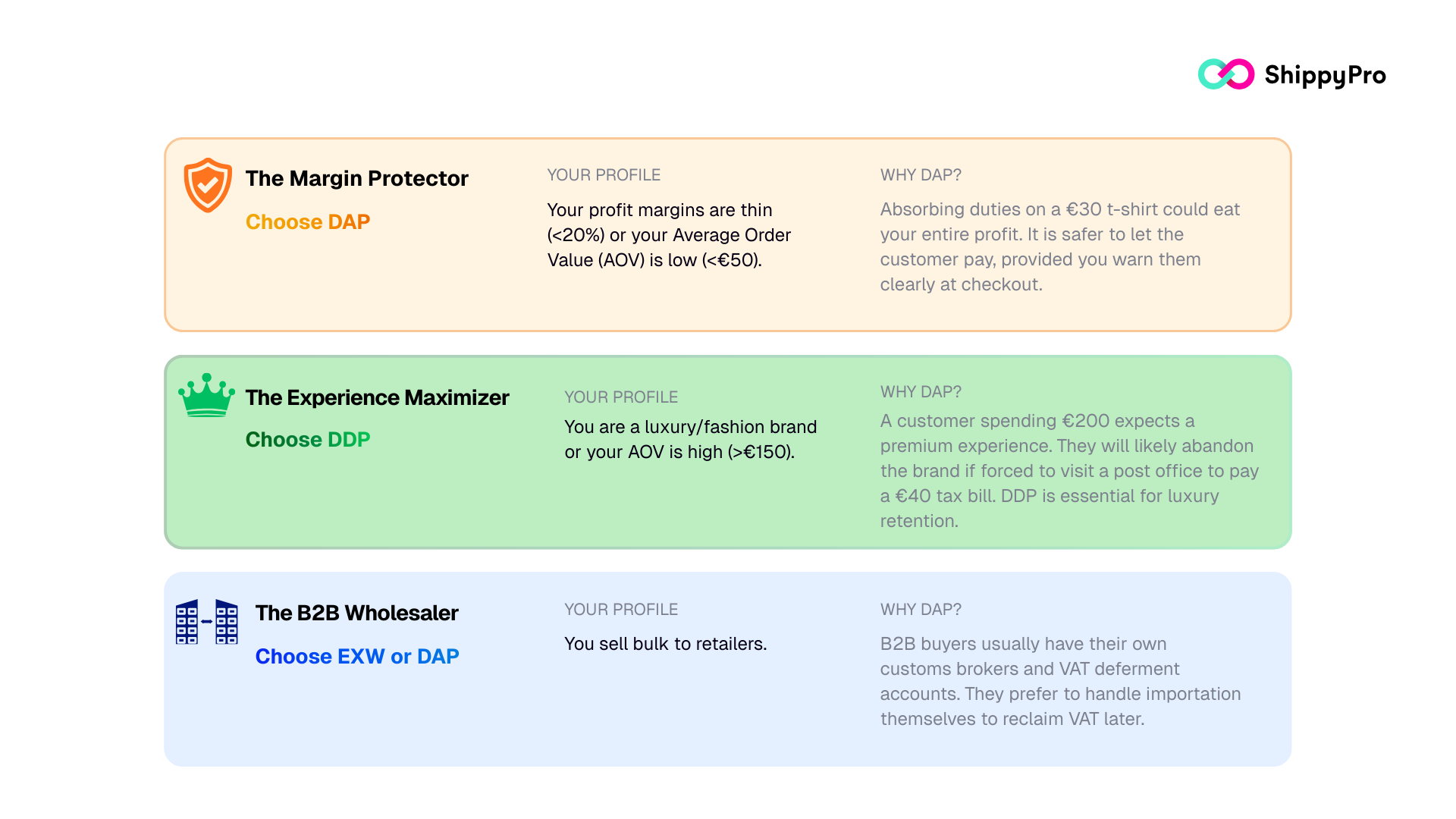
Don't guess. Use this logic flow to decide which term protects your bottom line.
Scenario A: The "Margin Protector" (Choose DAP)
- Profile: Your profit margins are thin (<20%) or your Average Order Value (AOV) is low (<€50).
- Why DAP? Absorbing duties on a €30 t-shirt could eat your entire profit. It is safer to let the customer pay, provided you warn them clearly at checkout.
Scenario B: The "Experience Maximizer" (Choose DDP)
- Profile: You are a luxury/fashion brand or your AOV is high (>€150).
- Why DDP? A customer spending €200 expects a premium experience. They will likely abandon the brand if forced to visit a post office to pay a €40 tax bill. DDP is essential for luxury retention.
Scenario C: The "B2B Wholesaler" (Choose EXW or DAP)
- Profile: You sell bulk to retailers.
- Why DAP? B2B buyers usually have their own customs brokers and VAT deferment accounts. They prefer to handle importation themselves to reclaim VAT later.
The Commercial Impact (Why it matters)
Choosing the wrong Incoterm isn't just a logistics issue; it's a Conversion Rate Optimization (CRO) issue.
The "Sticker Shock" Effect (DAP)
Imagine buying a sweater for €50. A week later, you receive a text from the courier demanding €22 in taxes and "admin fees" before they release the parcel.
- Result: The customer feels scammed.
- Statistic: 15–20% of DAP shipments to high-tax countries (like the UK, Brazil, or Canada) are rejected by customers at the door.
⚠️ The "Refusal" Trap: Under DAP, if a customer refuses to pay duties, the carrier will charge YOU the return shipping cost (often double the outbound rate) plus the original duties. A single refused DAP shipment can wipe out the profit of five successful orders.
The DDP Advantage
By using DDP, you present a "Total Landed Cost" at checkout. The customer pays €65 total (€50 sweater + €15 tax) in one click.
- ROI: Brands switching to DDP often see a 15–30% lift in checkout conversion because they remove the "fear of the unknown."
How to Implement DDP (The Tech Stack)
You don't need to be a tax lawyer to offer DDP. You need an automated integration stack.
-
At Checkout (Calculation): Use a plugin (like Zonos, Avalara, or Reach) to calculate duties dynamically based on the customer’s cart and geolocation.
-
On the Label (Carrier API): Your shipping management platform (like ShippyPro) acts as the bridge. When you print the label, ShippyPro flags the shipment as "DDP" in the carrier's API (e.g., DHL Paperless Trade) so the courier knows to bill your account, not the customer.
-
On the Invoice (Documentation): The Commercial Invoice must clearly state: “Incoterms: DDP. Taxes Billed to Sender.”
Frequently Asked Questions (FAQ)
Is DDU the same as DAP?
Yes. DDU (Delivered Duty Unpaid) was officially replaced by DAP (Delivered At Place) in the Incoterms 2010 update. However, many logistics providers still use "DDU" colloquially to mean the customer pays duties.
Does DDP include VAT?
Yes. DDP stands for Delivered Duty Paid. This means the seller covers Import Duty, VAT (Value Added Tax), and the carrier's customs handling fee.
Can I use DDP for all countries?
Not always. Some countries (like Russia or Brazil) make it difficult for foreign sellers to pay duties on behalf of the buyer. In these specific "hard-to-ship" lanes, falling back to DAP is often the only option.
Which carriers support DDP?
All major express carriers support DDP (DHL Express, FedEx, UPS). Many postal services also support it via "IOSS" (Import One-Stop Shop) for shipments to the EU under €150.

As the Growth Manager at ShippyPro, I help online retailers transform their shipping operations from a bottleneck into a growth engine. My expertise lies in ecommerce logistics and automation, specifically helping brands save time and scale efficiently. I write about the tools, strategies, and technologies that are defining the future of fulfillment.