



 By
·
14 minute read
By
·
14 minute read
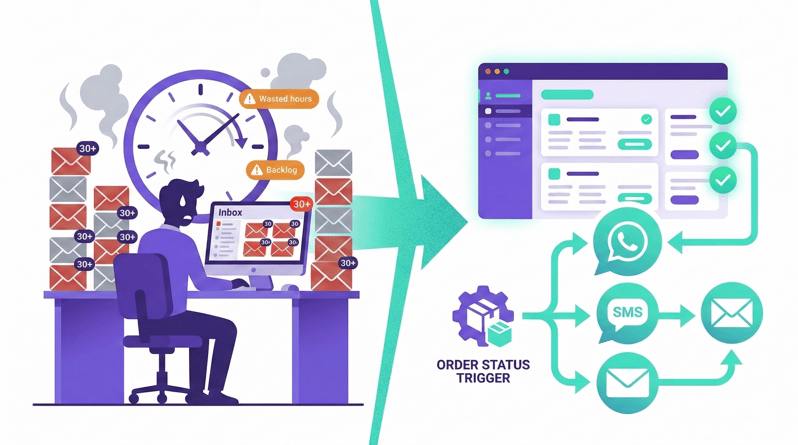
Every morning, the same ritual. Open inbox. Scroll past 30 to 40 "where is my order?" emails. Copy-paste tracking links one by one. Spend two to four hours on repetitive, zero-judgment-required work. Watch real customer issues get buried under the pile. Close the tab. Repeat tomorrow.
This isn't a support problem. It's a notification problem — and it's entirely solvable. The businesses winning in 2026 aren't the ones with the biggest support teams. They're the ones who recognised that 70 to 80 % of their support tickets never needed a human to answer them in the first place, automated away the question before it was ever asked, and redirected their team toward work that actually moves the needle.
This guide shows you exactly how to do that — from understanding why customers send WISMO emails in the first place, to the precise notification sequence that eliminates most of them, to the setup workflow you can complete in a single afternoon.
🗝 Key Takeaways
- WISMO emails account for 50 to 80 % of all support tickets. They are the single largest drain on your support team's time — and the vast majority require zero human judgment to resolve.
- Proactive notifications reduce WISMO by 50 to 80 %. The entire category of "did it ship / when does it arrive / did it get delivered?" disappears when customers receive clear, automatic updates at every milestone.
- One out-for-delivery SMS prevents three to five support tickets. It answers the question before it's asked, keeps the customer home to receive the package, and eliminates the failed delivery follow-up chain entirely.
- Email alone is no longer sufficient in 2026. 67 % of customers now expect SMS or WhatsApp alerts for time-sensitive delivery updates — up from 42 % in 2024. Email handles milestones; SMS and WhatsApp handle urgency.
- Setup takes hours, not weeks. Modern notification platforms eliminate custom development entirely. Every step in this guide is executable with drag-and-drop configuration — no engineering involvement required.
The Real Cost of WISMO: Beyond the Obvious Hours
The standard calculation goes: 30 WISMO tickets per day, four minutes each, equals two hours of daily waste. 520 hours per year. Thirteen full work weeks answering a question the customer should never have had to ask. That number is striking enough on its own.
But it misses the compounding damage that doesn't appear in any time-tracking report.
Support agents spending 60 to 70 % of their day on repetitive tracking responses experience cognitive fatigue that leads to the exact errors you least want to make — wrong tracking numbers sent to customers, wrong names in personalised responses, wrong carrier links. Each error escalates into a larger problem that takes ten times longer to resolve than the original WISMO would have. Your best support people are also the ones who eventually burn out and leave, because intelligent people don't stay in roles where they spend most of the day doing work that requires no intelligence. You hire replacements. You train them into the same broken process.
Meanwhile, the customer with a genuinely lost package — the one who actually needs a human — waits four hours for a response. By the time your team surfaces it from the WISMO pile, they've already called twice, left a bad review, and decided not to reorder. The support cost of one unhandled real exception is roughly equivalent to the WISMO cost of an entire week.
Of all WISMO tickets, roughly 90 % fall into categories that proactive notifications eliminate entirely: customers who deleted the confirmation email, customers confused by cryptic carrier status codes, customers experiencing delivery anxiety about a time-sensitive purchase. The remaining 10 % are genuine exceptions — lost packages, failed deliveries, address issues — that genuinely require investigation and human response. When your team is drowning in the 90 %, the 10 % that actually matters waits. Proactive notifications don't just save time; they surface the real problems faster by eliminating the noise around them.
Why Customers Actually Send WISMO Emails
Understanding the root cause matters because it changes the solution. Customers don't want to email support. They do it because they feel they have no choice — and the reasons break down clearly into four categories.
The largest category, roughly 40 % of WISMO, is lost tracking information. The confirmation email was deleted, archived, or never found. The customer can't locate the tracking number in their account. They find a tracking number but the carrier's own tracking page is confusing, slow, or returns an unhelpful status. The fix here is a branded tracking page linked from every notification — one URL the customer can bookmark and return to at any point.
The second category, around 30 % of WISMO, is cryptic status codes. "In transit" communicates nothing about when the package arrives. "Information received" is ambiguous — does it mean shipped, or just that a label was printed? A status that hasn't updated in three days reads as alarming even when the package is moving normally. The fix is human-readable status messages that explain what's actually happening, not carrier-generated codes translated literally.
The third category, about 20 %, is delivery anxiety — a customer who paid for something important and needs certainty it's actually coming. Previous bad experiences with carriers, a delivery window that coincides with a work trip, a gift that needs to arrive on a specific date. The fix is an out-for-delivery notification sent on the day of arrival, ideally via a channel the customer reads in minutes rather than hours.
The fourth category, roughly 10 %, is genuine problems: failed delivery, significant delay, wrong address, customs hold. These require a human. The goal of your notification system is to eliminate categories one through three so your team can focus entirely on category four.
Customer buys. Waits. Hears nothing. Searches inbox. Finds no tracking link. Checks spam. Goes to carrier website. Confused by status codes. Emails support. Waits 4 hours. Gets a copy-pasted tracking link. Still doesn't understand when it arrives. Emails again. Your agent — who's already answered 25 versions of this today — makes a typo. Escalation. The customer who actually lost their package is still waiting in queue.
Customer buys. Within 30 minutes of label creation: branded confirmation email with tracking link and delivery date. Day of delivery: WhatsApp or SMS — "Your order arrives today." Delivered: confirmation email with review request. Customer never had a question because every question was answered before it formed. Support team handles eight tickets instead of thirty. The one with the genuinely lost package gets a response in twelve minutes.
What Changed in 2026: Why This Is More Urgent Now
Several developments in 2026 have raised both the opportunity and the stakes around notification automation.
Major carriers including DHL Express, UPS, and FedEx updated their tracking data availability standards at the start of the year. Real-time status updates are now possible where previously there was a two to four hour delay — which means out-for-delivery notifications can now be sent the moment the carrier updates the status, rather than hours later when the window has already partially closed.
Platform expectations have also shifted. Shopify, WooCommerce, and BigCommerce now recommend multi-channel notifications in their own setup wizards. Single-channel email-only notification is no longer considered best practice by the platforms themselves. If you're operating on email alone, you're behind the current baseline recommendation of the tools you're already using.
Customer expectations have moved furthest. 67 % of customers now expect SMS or WhatsApp alerts for delivery updates — up from 42 % in 2024. Amazon Prime same-day delivery notifications have set a baseline that customers apply to every purchase regardless of seller size. Your notification experience is compared not to other small brands but to the best experience the customer has ever had. Email fatigue continues to compress open rates even as subject line optimisation improves. The channel gap between email and SMS/WhatsApp on time-sensitive messages has widened to the point where email alone creates a structural disadvantage.
The Four-Notification Sequence That Eliminates 80 % of WISMO
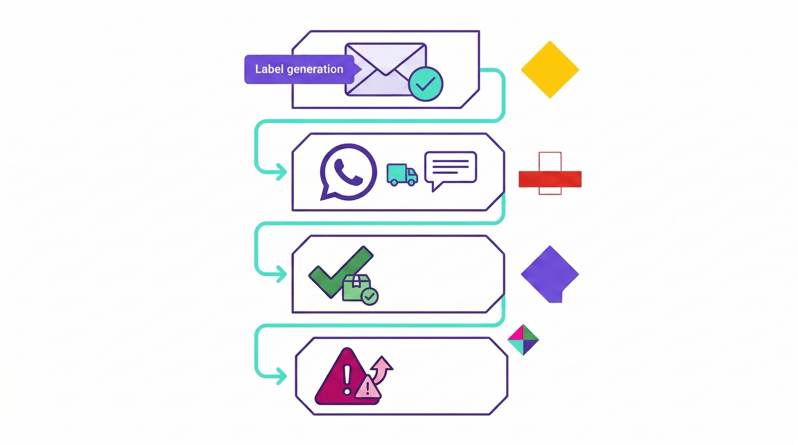
The complete solution is four notifications, each targeting a specific WISMO category, each sent via the right channel at the right moment. Implemented together, they eliminate the need for customers to contact support about tracking in the vast majority of cases.
Notification 1: Shipment Confirmation
Sent within 30 minutes of label creation. Channel: email. Content: clear statement that the order is on its way, tracking number linked to your branded tracking page (not the carrier's generic page), estimated delivery date in plain language, and a single line explaining what to do if something seems wrong. This notification eliminates 25 to 30 % of WISMO — every customer asking "did it ship yet?" — entirely. The branded tracking page link is critical: it creates a consistent, readable status experience that prevents the "cryptic status codes" WISMO category from generating follow-up questions.
Notification 2: Out-for-Delivery Alert
Sent on delivery day when the carrier updates status to "Out for Delivery." Channel: SMS or WhatsApp — not email. This is time-sensitive information. Email is read in hours; SMS and WhatsApp are read in minutes. The content is short: confirmation the package arrives today, delivery time window if available, any relevant instructions (signature required, ring bell, gate code). This single notification eliminates 35 to 40 % of WISMO on its own — every "when does it arrive?" question — and reduces failed first-delivery attempts by 25 to 35 % because customers who know their package is coming today make themselves available to receive it. The downstream cost savings from avoided failed deliveries frequently exceed the cost of the notification platform itself.
A single well-timed out-for-delivery SMS prevents three to five support tickets: the "when does it arrive?" inquiry, the "I missed the delivery, what happens now?" follow-up, the "can you redeliver?" request, and in many cases the "I want a refund" message that comes when a time-sensitive delivery fails. For carriers like Royal Mail, Evri, and DPD that make one delivery attempt before leaving a card, the out-for-delivery notification is the difference between a resolved order and a multi-day support chain. Use ShippyPro Track & Trace to trigger this notification automatically the moment the carrier event fires — no manual monitoring required.
Notification 3: Delivery Confirmation
Sent when the carrier confirms successful delivery. Channel: email. Content: confirmation the package was delivered, timestamp and location details if available, and a clear call to action — "check your order and let us know if anything's wrong within 24 hours." That last line is more important than it looks. Proactively inviting the customer to flag issues within a short window gives you immediate visibility into damaged goods, wrong items, and missing items before they escalate into return requests or chargebacks. Merchants who add this line report 15 to 20 % reductions in return-related inquiries because problems get caught and resolved faster. The delivery confirmation also eliminates the "did it arrive?" WISMO category entirely — roughly 20 % of tickets — and creates a natural review request opportunity at the moment of highest customer satisfaction.
Notification 4: Exception Alerts
Sent when something goes wrong — delay, failed delivery attempt, address issue, customs hold. Channel: SMS or WhatsApp immediately, followed by email with more detail. The content must be human-readable. Not "Exception code 7B: address query raised." Something like: "We tried to deliver your order today but no one was home. Here's how to arrange redelivery: [link]." The impact of exception notifications is not ticket volume reduction — it's ticket severity reduction. A customer who learns about a delivery failure from your proactive notification is significantly less frustrated than one who discovers it by checking the carrier's tracking page three days after the failed attempt. The same problem handled proactively generates a brief "thanks for letting me know" interaction. Handled reactively, it generates an angry escalation.
The Numbers: What This Actually Saves
| Metric | Current (Reactive) | With Proactive Notifications | Saved |
|---|---|---|---|
| WISMO tickets/day | 30 | 9 | 21 tickets |
| Time per day | 120 min | 36 min | 84 minutes |
| Time per week | 10 hours | 3 hours | 7 hours |
| Time per month | 40+ hours | 12 hours | 28 hours |
| Time per year | 520 hours | 156 hours | 364 hours (9.1 work weeks) |
| Cost at £35/hr fully loaded | £18,200/year | £5,460/year | £12,740/year |
These are conservative numbers assuming a 70 % WISMO reduction. Many merchants report 80 %+ reductions after implementing the full four-notification sequence. The cost-per-notification via SMS or WhatsApp is a fraction of the £15 to £25 cost-per-WISMO-ticket when you include agent time, tooling, and management overhead. The math makes the decision straightforward.
Channel Strategy: Email vs. SMS vs. WhatsApp
The right channel depends on what you're communicating and when the customer needs to act on it.
| Notification | SMS | Best Choice | ||
|---|---|---|---|---|
| Order confirmation | ✅ Yes | Not needed | Not needed | Email — customers want the reference |
| Shipment confirmation | ✅ Yes | Optional | Optional | Email — detailed information, trackable link |
| Out for delivery | Backup only | ✅ Primary | ✅ Primary | SMS or WhatsApp — time-sensitive, needs minutes not hours |
| Delivery confirmed | ✅ Yes | Optional | Optional | Email — reference value, review opportunity |
| Exception alert | ✅ Yes | ✅ First | ✅ First | SMS/WhatsApp immediately, then email with detail |
For the UK and US markets, SMS is the primary real-time channel — open rates above 98 %, read within 3 minutes on average. WhatsApp is growing quickly in the UK as adoption expands beyond personal use. For European markets broadly, WhatsApp is already the preferred channel for delivery notifications — particularly relevant if you ship internationally. ShippyPro Track & Trace handles multi-channel routing automatically, sending each notification type to the right channel without manual configuration per order.
The Setup Workflow: Five Steps to Complete This Afternoon
Different carriers use different terminology for the same events. "Out for Delivery" at DHL Express, "With Delivery Courier" at Royal Mail, "On Board for Delivery" at Evri — these all map to the same notification trigger. List every carrier you use and confirm which status code fires your out-for-delivery alert. ShippyPro normalises carrier status events across 160+ carriers automatically, so you configure the trigger once and it applies to every carrier in your mix.
Avoid carrier-style language. "Package status updated: In Transit. Reference #XXXXX" is technically accurate and completely useless. "Your [Product] is on the way — arrives by [Date]. Track here → [link]" answers every question the customer has. Write one version of each of the four core messages — shipment confirmation, out-for-delivery, delivery confirmation, exception — before touching any platform settings. Getting the content right first makes configuration faster and avoids the trap of going live with generic copy.
Standard orders need the four core notifications. International orders need customs information added to the shipment confirmation. High-value orders (above £150) benefit from a delivery confirmation requirement flag. Express orders should have shorter, more precise time windows in their out-for-delivery messages. Repeat customers can receive a referral offer in the delivery confirmation email. None of this requires code — in ShippyPro's notification builder, these are if/then rules set up in a drag-and-drop interface.
Place five to ten test orders covering your typical mix — domestic standard, domestic express, international, one with an address that will require manual review. Monitor every notification: does it fire at the right moment, does it arrive on the right channel, does the content display correctly on mobile, does the tracking link work? A ten-minute test prevents the scenario of going live with a broken notification that sends 400 customers a blank email on Monday morning.
Activate notifications for all customers. For the first two weeks, track three numbers: notification delivery rate (should be above 95 %), WISMO ticket volume (should drop within 48 hours of launch), and failed delivery rate (should drop within the first week as out-for-delivery alerts keep customers available). After two weeks you have enough data to identify any notification that isn't performing — wrong timing, wrong channel, content that's generating confusion rather than clarity — and adjust before it becomes a permanent fixture.
Writing Notifications That Actually Work
The technical setup is the easier half of this problem. The harder half is writing notification content that answers questions instead of generating them. The gap between good and bad notification copy is larger than most people expect — and it maps directly to whether your WISMO reduction is 40 % or 80 %.
The pattern that works consistently: lead with what the customer cares about (the status of their order), follow with the specific detail they need (delivery date, time window, or what happened), and end with a single clear action if one is required. "Your package arrives today" is better than "Shipment status update." "We tried to deliver your order but no one was home — click here to rebook" is better than "Delivery attempt notification." The goal is that after reading the notification, the customer has no remaining question that would prompt them to contact support.
This is the most frequently missed step in notification setup. If you activate ShippyPro's branded notifications without disabling carrier-native notifications (DHL, Royal Mail, Evri, DPD all send their own by default), customers receive duplicate messages from different senders with different formatting and sometimes conflicting information. The result is more confusion, not less — and your WISMO reduction will be significantly below what it should be. Disable carrier-native customer notifications in each carrier portal before going live.
Beyond WISMO: What Proactive Notifications Do for Your Business
The direct benefit is clear: fewer support tickets, less time wasted, lower cost per order. But the secondary effects of operating a proactive notification system are worth understanding, because they compound over time in ways the ticket-count calculation doesn't capture.
Customer relationships improve measurably. A customer who receives clear, well-timed updates throughout their delivery experience feels informed and valued — even when something goes wrong, proactive communication of the problem generates significantly more goodwill than silence followed by a reactive apology. Net Promoter Scores and review quality both improve when the post-purchase communication experience is consistent and reliable.
Return rates decline. The 24-hour delivery confirmation message — "let us know if anything's wrong" — catches damaged goods, wrong items, and missing items while the customer is still in the "just received this" mindset rather than the "this has been sitting in the corner unresolved for two weeks" mindset. Problems caught within 24 hours are resolved at a fraction of the cost of problems that surface as chargebacks or formal returns a week later.
Repeat purchase rates increase. Delivery experience is one of the strongest predictors of whether a customer reorders. A clean, informed, no-friction delivery experience — where the customer never had to wonder where their package was — converts first-time buyers into returning customers at meaningfully higher rates than an experience where the customer had to chase information. The Easy Return portal paired with proactive delivery notifications creates a full post-purchase experience that handles both successful and unsuccessful deliveries cleanly.
Track & Trace
Automated branded notifications via email, SMS, and WhatsApp — triggered by real-time carrier events across 160+ integrated carriers. Normalises carrier status codes automatically. Branded tracking page included.
Eliminate WISMO tickets →AI Shipping Automation
Visual rule builder for notification logic — set conditional rules by order value, destination, carrier, shipping method, or customer type. No code, no developer. Configure once, runs on every order.
Build notification rules →Shipping Platform
Central dashboard connecting 160+ carriers and 80+ e-commerce platforms. Label generation, carrier selection, and notification automation from a single interface — no separate tools required.
Explore the platform →Easy Return
Branded self-service returns portal that completes the post-purchase experience loop — automatic return label generation, return tracking, and inventory update triggers without support team involvement.
Automate returns →Shipping Automation: What to Automate First
The proven sequencing that maximises automation ROI from day one — notifications are Priority 5, not Priority 1. Understand what to build first so notifications land on a stable operational foundation.
Read the guide →Resources & Guides
Practical guides for e-commerce operations teams on shipping automation, carrier management, post-purchase experience, and peak season preparation.
Browse resources →How much time will proactive notifications actually save my support team?
Conservative estimate based on a 70 % WISMO reduction: 28 to 35 hours per month for a team handling 30 WISMO tickets per day. At a fully-loaded cost of £35/hour for operations staff, that's approximately £12,000 to £15,000 annually from WISMO reduction alone — before factoring in the reduction in failed deliveries (each avoided costs £12 to £25 in redelivery and support handling) and the improvement in customer retention from a better post-purchase experience. Some merchants with higher WISMO rates report savings exceeding 50 hours per month.
Won't customers just ignore the notifications?
SMS has a 98 %+ open rate and is read within 3 minutes on average. WhatsApp has 90 %+ open rates. Email is lower at 30 to 50 %, but even at that rate, the notifications are doing their job — they're providing information proactively rather than waiting for the customer to ask. The goal isn't engagement; it's preemptive information delivery. Even a customer who never opens your shipment confirmation email is less likely to email support if they received a clear out-for-delivery SMS on delivery day.
Is email alone sufficient, or do I really need SMS and WhatsApp?
Email alone works — but it's structurally limited for time-sensitive messages. Email is typically read hours or days after delivery, which means an out-for-delivery notification sent by email often arrives after the delivery window has already closed. For milestone notifications (shipment confirmation, delivery confirmation), email is the right channel. For time-sensitive messages (out for delivery, exception alerts), SMS or WhatsApp is significantly more effective. 67 % of customers now expect real-time alerts via these channels — operating email-only is increasingly a competitive disadvantage rather than a neutral choice.
How do I handle conditional logic — different messages for international orders, high-value orders, express shipping?
In ShippyPro's notification builder, conditional rules are configured with drag-and-drop if/then logic — no developer required. "If destination country is not UK → add customs information to shipment confirmation." "If order value exceeds £200 → require delivery signature and update out-for-delivery message." "If shipping method is express → use tighter delivery window language." These rules apply automatically to every qualifying order without manual review. You configure the logic once and it runs indefinitely without maintenance.
What happens if a carrier API goes down and notifications stop firing?
ShippyPro monitors carrier API status in real time across all 160+ integrated carriers. When a carrier API experiences downtime, the platform queues pending notifications and delivers them when the connection restores rather than dropping them silently. For extended outages, the platform's status monitoring surfaces the issue so you can proactively communicate with affected customers rather than discovering the problem from a wave of WISMO tickets. The 99.9 % uptime SLA covers the notification delivery infrastructure itself.
Stop answering the same question 30 times a day.
Set up automated proactive notifications across DHL Express, Royal Mail, Evri, DPD, UPS and 160+ carriers in hours — not weeks. No custom development. No credit card required to start.
Start Free Trial →
The Product Team at ShippyPro is dedicated to building innovative solutions that empower businesses to simplify their shipping operations. By combining customer research with cutting-edge technology, we design features that enhance efficiency, reduce effort, and boost logistics flexibility.