



 By
·
12 minute read
By
·
12 minute read
Every customer who completes a purchase asks the same question the moment they hit "order": when will it arrive? For years, independent brands have answered that question with a shrug dressed up as a date range: "3–5 business days" or "Allow 5–7 working days". Vague windows that shift responsibility onto the customer and erode the trust you worked hard to build. Meanwhile, the large platforms like Amazon, Zalando, major marketplaces have been giving shoppers a specific date, often down to the hour. That gap isn't a carrier problem, but a data problem and predictive parcel delivery is how it gets solved.

🗝 Key Takeaways
- Predictive delivery dates use machine learning: They analyse carrier performance history, route data, and transit patterns to forecast exactly when a parcel will arrive, before it ships and throughout transit.
- Vague windows cost real money: Uncertain delivery expectations drive cart abandonment at checkout, inflate WISMO support tickets and push customers toward platforms that do offer specific dates.
- Accuracy is now measurable: ShippyPro's Delivery Prediction model achieves 78% overall accuracy and 90% accuracy for the top 10 carriers in the network, within an average 17-hour prediction window.
- It's not just about the ETA: Data-driven predictive delivery dates enable smarter carrier selection, proactive exception management and SLA monitoring before a delay becomes visible to the customer.
- SMBs can now access what only big platforms had: Delivery prediction closes the gap between independent brands and marketplace giants, with no data science team or carrier contract volume required.
📋 In this article
- What is predictive parcel delivery?
- Why vague delivery windows hurt your business
- How delivery date prediction actually works
- From SMB to enterprise: who benefits and how
- Using predictive data for smarter carrier decisions
- ShippyPro Delivery Prediction: what it does and how accurate it is
- Beyond the ETA: what else predictive data enables
- Resources
- Frequently asked questions
What is predictive parcel delivery?
Predictive parcel delivery is the use of machine learning models to forecast the exact date (and increasingly, the time window) when a shipment will be delivered, based on historical and real-time data rather than a carrier's static service-level commitment.
A carrier might advertise "2-day delivery" for a given service. But that's a marketing promise, not a data-driven estimate. What actually happens depends on the origin postcode, the destination zone, the day of the week, seasonal demand, the specific carrier depot handling the parcel and dozens of other variables that shift constantly. A predictive delivery model ingests all of that, learns from millions of historical shipments, and produces a forecast that reflects how that route actually performs, not how it's supposed to perform.
The difference between an ETA and a predictive delivery date
An ETA (estimated time of arrival) is typically calculated by adding the carrier's stated transit time to the dispatch date. It's linear and static. A predictive delivery date is dynamic: it updates as the shipment moves through the carrier network, adjusting based on scan events, known delays at specific hubs, and real-time carrier performance signals. The two can look identical on the surface, but they diverge substantially when conditions change.
Why this matters now
Consumer expectations have been reset by large platforms. Research consistently shows that nearly half of consumers abandon their carts when delivery isn't clear, and 60% will choose a competitor that offers an exact arrival date over one that doesn't. When shoppers can get a specific, reliable delivery date from a marketplace and only a vague window from an independent brand, the conversion gap is predictable. Predictive delivery tools are how independent brands compete on the post-purchase experience without needing Amazon's logistics infrastructure.
Why vague delivery windows hurt your business
The "3–5 business days" window isn't neutral. It has measurable costs at every stage of the customer journey, and most merchants only see the symptoms rather than the cause.
Customer sees "3–5 business days" at checkout. They're unsure if the order will arrive before the weekend event they're buying for. They abandon the cart. If they do order, they email support two days later asking where their parcel is. Your team spends time on reactive WISMO tickets. The parcel arrives on day 4, but without any proactive update, the customer's experience is anxiety, not delight.
Customer sees "Arrives Thursday 29 May" at checkout. They know it arrives before their event. Conversion increases. After dispatch, they receive a proactive notification when the predicted window updates. No support tickets. The parcel arrives Thursday. The customer's experience is confidence and trust.
The checkout conversion impact
Delivery uncertainty is one of the most cited reasons for cart abandonment. When a customer cannot confirm that a purchase will arrive in time for a specific need, they either delay the decision or go elsewhere. A specific, data-driven delivery date removes that blocker. It doesn't need to be guaranteed — it needs to be credible. A date generated from real performance data is credible in a way that a carrier's blanket service commitment is not.
The WISMO cost
"Where Is My Order?" tickets are expensive to handle and almost entirely preventable with the right information. WISMO contacts account for 30–40% of all inbound support volume for e-commerce brands, a share that climbs further during peak season. When customers have a specific expected delivery date and receive proactive updates if that date changes, the reason to contact support largely disappears which means the cost saving compounds quickly at scale.
The carrier selection blind spot
Most e-commerce merchants select carriers based on published rates and nominal transit times. Neither reflects actual delivery performance on specific routes. Without data-driven predictive delivery dates, you can't know whether the carrier you're choosing for a Tuesday dispatch to a rural postcode typically delivers in 2 days or 4. Predictive data makes that comparison possible at the moment of label creation.
Stop guessing when parcels will arrive. Start knowing.
ShippyPro's Delivery Prediction model generates specific, data-driven delivery dates for every shipment — before it ships, and updated throughout transit.

How delivery date prediction actually works
Understanding the mechanics helps you evaluate any delivery prediction platform, including how to assess its accuracy claims.
The model ingests millions of shipment records: origin, destination, carrier, service level, dispatch date, intermediate scan events and final delivery timestamp. The larger and more carrier-diverse the dataset, the more accurate the model's baseline.
The raw shipment records are transformed into predictive features: route-level performance distributions, day-of-week patterns, seasonal demand curves, carrier depot performance scores, and distance bands. These features feed the machine learning model.
When a label is created, the model scores the shipment against its learned patterns and outputs a predicted delivery date (or range). This pre-dispatch prediction can be shown at checkout, in confirmation emails, or used for carrier selection.
As the parcel moves and carrier scan events are received, the model recalculates. If a scan shows the parcel at an unexpected hub or if a known delay pattern is detected at a specific depot, the predicted delivery date adjusts. This continuous updating is what separates a dynamic prediction from a static ETA.
The delivery forecast isn't just a display field. It drives notifications, exception alerts, carrier performance reports, and SLA monitoring. The prediction becomes the operational baseline from which all post-purchase workflows run.
What good prediction accuracy looks like
Accuracy in delivery prediction is measured as the percentage of shipments where the actual delivery date falls within the predicted window. The tighter the window and the higher the percentage, the better the model. A wide window (say, "3–5 days") is trivially easy to satisfy but useless for the use cases that matter. A narrow window (17 hours) with high accuracy is operationally meaningful.
| Prediction window | Accuracy required to be useful | Use case it enables |
|---|---|---|
| 3–5 days (carrier SLA) | Trivial — almost any shipment qualifies | None beyond bare compliance |
| ±1 day | 70%+ meaningful for checkout display | Checkout conversion, confirmation emails |
| ~17 hours | 75%+ operationally valuable | Proactive customer notifications, exception detection |
| Time-of-day (AM/PM) | 60%+ useful for premium services | Premium delivery promise, B2B SLA management |
The role of carrier data quality
The single biggest variable in prediction accuracy is the quality and frequency of carrier scan events. Carriers that provide dense, real-time tracking data (multiple scans per day, including hub processing and out-for-delivery events) enable far more accurate predictions than carriers whose data arrives in sparse batches. This is why prediction accuracy varies significantly by carrier and why a platform integrated with many carriers can surface material accuracy differences between them for the same route.
From SMB to enterprise: who benefits and how
The use cases for data-driven predictive delivery dates differ depending on where you sit, but the core value, replacing guesswork with a specific, defensible forecast, applies across the board.
For SMB brands
The most immediate gain for smaller merchants is checkout parity with the major platforms. Customers who buy from independent brands have been conditioned by marketplace experiences to expect a specific date. Showing "Arrives Friday 30 May" instead of "3–5 business days" narrows the conversion gap without requiring any change to your carrier contracts or fulfilment infrastructure. The prediction model does the work that, until now, only platforms with massive carrier volume could afford to build.
The secondary gain is WISMO reduction. For a small team, every customer service contact has a high relative cost. Proactive notifications triggered by the delivery prediction — including early alerts when a shipment is trending late — mean customers receive an update before they feel the need to ask. That's a support cost that scales down as order volume scales up.
Tools like ShippyPro's Track & Trace and shipping notifications are built to work in concert with delivery prediction, so the forecast feeds directly into customer-facing communications without additional integration work.
For enterprise brands
Enterprise brands often have the reverse problem: they have carrier data, but it's siloed across disconnected tools. A CRM, a CS platform, a carrier portal, and a warehouse management system may each carry a different version of the expected delivery date, creating inconsistency in customer communications. A native delivery prediction capability exposed via API resolves this by providing a single, continuously updated source of truth that every system can query.
For brands with contracted SLAs, delivery prediction enables proactive SLA monitoring. Rather than discovering at month-end that a carrier missed its committed delivery window on 12% of shipments, a prediction model can flag at-risk shipments in real time — early enough to intervene, escalate, or at minimum communicate proactively to the customer.
| Business size | Primary benefit | Key use case | Integration path |
|---|---|---|---|
| SMB (under 500 orders/month) | Checkout conversion improvement | Specific delivery date at checkout and in confirmation email | ShippyPro (Tracking Solver, Delivery Forecast column) |
| Mid-market (500–5,000 orders/month) | WISMO reduction + carrier performance visibility | Proactive exception notifications before customer contacts | ShippyPro + notification workflows |
| Enterprise (5,000+ orders/month) | SLA monitoring + tech stack integration | Real-time delivery date in CRM, CS tools, and checkout | ShippyPro API |
Using predictive data for smarter carrier decisions
One of the less obvious applications of delivery prediction is at the moment of label creation. Most carrier selection decisions today are based on two variables: price and nominal transit time. Both are incomplete signals.
Price doesn't account for the cost of a late delivery (compensation, repeat shipments, customer service contacts). Nominal transit time is a carrier's self-reported figure, not an empirical one. A prediction model that has scored millions of actual shipments on a given route knows whether carrier A typically delivers in 2 days or 3 days to a specific postcode zone and that knowledge changes which carrier is the right choice, not just the cheapest one.
Route-level performance vs. carrier-wide averages
Carrier performance is not uniform. A carrier that achieves 95% on-time delivery nationally may perform at 80% for a specific origin-destination pair due to a depot bottleneck, a rural last-mile challenge, or a structural gap in their network for that geography. Aggregate performance figures hide this variance. A route-level predictive model exposes it.
This is the foundation of what ShippyPro's Optimizer does: compare carriers not just on cost but on predicted delivery performance for the specific shipment being created. Combine that with AI-driven shipping automation rules and the right carrier is selected automatically, based on real delivery data rather than assumptions.
Carrier service level agreements describe the transit time under normal conditions. They are not predictions. A carrier advertising "2-day delivery" for a given service may achieve that rate on 75% of shipments, or 60%, depending on the route and time of year. Always evaluate carrier performance using empirical delivery data, not SLA commitments alone. Any platform claiming delivery prediction accuracy based on SLA data rather than historical actual delivery records is not offering genuine machine learning prediction.
How predictive data integrates with carrier selection workflows
In a mature implementation, delivery prediction feeds into carrier selection as follows: at the point of label creation, the platform queries the prediction model for each available carrier on the route. The model returns a predicted delivery date and a confidence score for each. The selection logic, whether manual or automated, can then factor in predicted delivery performance alongside cost. For merchants with multi-platform integrations, this can run automatically across WooCommerce, Shopify, Magento, and other channels without any manual intervention per shipment.
ShippyPro Delivery Prediction: what it does and how accurate it is
ShippyPro Delivery Prediction is the first machine learning model built by ShippyPro. It predicts the exact delivery date for every shipment before it ships, and updates that prediction continuously throughout transit as carrier scan events are received.
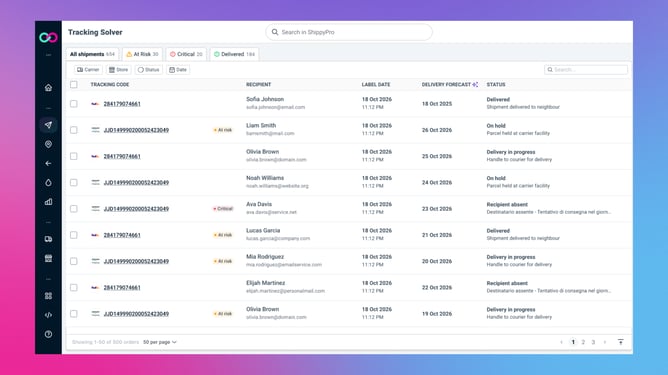
The model is currently live in Beta inside Tracking Solver, visible as the Delivery Forecast column. API access is in development, which will open up checkout, notification, and CRM use cases for merchants who want to surface the prediction across their full tech stack.
Accuracy benchmarks
Accuracy is defined as the percentage of predictions where the actual delivery falls within the predicted date range (average prediction window: 17 hours).
| Scope | Accuracy | Prediction window |
|---|---|---|
| Overall (all carriers) | 78% | ~17 hours |
| Top 10 carriers in ShippyPro network | 90% | ~17 hours |
These figures are measured live against actual delivery outcomes, not against carrier SLAs. The data science team continues to iterate on the model, and accuracy is expected to improve as the training dataset grows and model refinements are released.
Even before API access is available, the Delivery Forecast column in Tracking Solver is useful for daily exception management. Sort active shipments by predicted delivery date and filter for those where the prediction has moved later than the original estimate. These are the shipments at risk of generating a customer contact — reaching out proactively before the customer asks turns a potential complaint into a positive service moment.
Beyond the ETA: what else predictive data enables
The delivery date forecast is the most visible output of a prediction model, but it's the foundation for a broader set of capabilities that become possible once you have a continuously updated, data-driven delivery date for every shipment in transit.
A delivery promise at checkout
Showing a specific, reliable delivery date before the customer places the order is the highest-value application of predictive delivery data. It requires the prediction to be available pre-dispatch (before a label is created) and fast enough to render at checkout without adding latency. When this is in place, the checkout experience for an independent brand matches what customers expect from the major platforms — a specific date, not a range.
Proactive customer communication
Traditional shipping notifications are triggered by carrier events: "your order has shipped," "your order is out for delivery." They are reactive. Predictive notifications are different: they are triggered by changes to the delivery forecast, not just by carrier scans. If a shipment's predicted delivery date moves from Thursday to Friday, the customer can be notified on Wednesday — before they've checked tracking, before they've sent a support message. That proactive communication is what post-purchase experience looks like when it's done well.
SLA and carrier performance monitoring
For brands with carrier contracts that include performance commitments, delivery prediction enables a new kind of monitoring. Rather than measuring SLA compliance after the fact, at month-end or quarter-end, the prediction model flags shipments that are trending toward a breach in real time. This means you can act — contact the carrier, offer a proactive remedy to the customer, or simply document the failure for future contract negotiations — while the shipment is still in transit.
The Invoice Analysis capability in ShippyPro complements this: once you know which carrier missed their commitment, you have the shipment-level data needed to pursue a credit or refund on your carrier invoice. Predictive delivery data and invoice reconciliation together create a closed loop for carrier performance management.
AI-driven predictive analysis in logistics is moving from exception reporting to proactive intervention and the brands that build that capability now will have a structural advantage as the tools mature.
Delivery Prediction (Beta)
The Delivery Forecast column is live in Tracking Solver. See predicted delivery dates for every active shipment in your account.
Explore Track & Trace →AI Shipping Automation
Combine delivery prediction with automated carrier selection rules to route every shipment to the right carrier based on predicted performance, not assumptions.
See AI Automation →Shipping Notifications
Trigger customer notifications based on delivery forecast changes, not just carrier scan events. Proactive communication, automatically.
See Notifications →Track & Trace for E-Commerce
How to give every customer real-time shipment visibility across all your carriers, from a single dashboard.
Browse Resources →ShippyPro API Documentation
Technical documentation for integrating ShippyPro's shipping capabilities — including upcoming Delivery Prediction API access — into your checkout and CS platforms.
View API Docs →ShippyPro Resources Hub
Guides, tools, and documentation covering the full ShippyPro platform, from label generation to post-purchase analytics.
Visit Hub →What is predictive parcel delivery and how is it different from a standard ETA?
Predictive parcel delivery uses machine learning to forecast when a shipment will actually be delivered, based on historical transit data, route-level carrier performance, and real-time scan events. A standard ETA simply adds the carrier's stated transit time to the dispatch date — it's static and doesn't account for real-world variables. A predictive delivery date updates continuously as the shipment moves, reflecting what is actually happening in the carrier network rather than what the SLA says should happen.
How accurate are data-driven predictive delivery dates?
Accuracy depends on the quality of the training data and the carrier's tracking data density. ShippyPro's Delivery Prediction model achieves 78% overall accuracy and 90% accuracy for the top 10 carriers in its network, measured against an average prediction window of 17 hours. These figures are measured against actual delivery outcomes, not against carrier SLA commitments. Accuracy improves as the dataset grows and as model iterations are released.
Can delivery prediction help reduce cart abandonment?
Yes. Delivery uncertainty at checkout is one of the most commonly cited causes of cart abandonment. When a specific, credible delivery date replaces a vague "3–5 business days" window, customers who need to know if an order will arrive in time for a specific occasion can make a confident decision. The date doesn't need to be guaranteed — it needs to be grounded in real delivery data, which makes it meaningfully more credible than a carrier's blanket service-level promise.
Where does ShippyPro's Delivery Prediction currently live?
The model is live in Beta inside Tracking Solver, visible as the Delivery Forecast column. It shows a predicted delivery date for every active shipment in your account. API access is in development, which will enable the prediction to be used at checkout, in notifications, and across external systems like CRM and customer service platforms.
Do I need a large shipping volume to use delivery prediction?
No. ShippyPro's Delivery Prediction model is trained on data from the entire ShippyPro network, not from individual merchant volumes. An SMB shipping 50 orders a month has access to the same prediction quality as a high-volume enterprise customer, because the model draws on network-wide carrier performance data rather than requiring you to generate sufficient data yourself. This is the key difference from building a prediction model in-house, which does require substantial carrier volume.
Predictive delivery dates are no longer a big-platform exclusive.
ShippyPro Delivery Prediction gives every merchant — SMB to enterprise — a specific, data-driven delivery date for every shipment. It's live in Beta now, inside your ShippyPro account. See it in action with a free 14-day trial.

The Product Team at ShippyPro is dedicated to building innovative solutions that empower businesses to simplify their shipping operations. By combining customer research with cutting-edge technology, we design features that enhance efficiency, reduce effort, and boost logistics flexibility.