



 By
·
10 minute read
By
·
10 minute read
Every carrier invoice you receive contains a line item that most e-commerce merchants never look at closely: the fuel surcharge. In normal conditions, it is easy to ignore. In 2026, with fuel prices at decade highs following the disruption to global oil flows through the Strait of Hormuz, fuel surcharges across major carriers have reached historic levels, with further increases already embedded in the billing pipeline. If you are not actively monitoring this charge, you are very likely paying more than your contract requires.

🗝 Key Takeaways
- What a fuel surcharge is: A variable fee added on top of base shipping rates. It compounds across other accessorial charges on the same invoice, a dynamic known as surcharge stacking.
- Update cycles: Carriers update surcharge rates on weekly or monthly cycles with no obligation to notify you. Costs can change four or more times within a single billing period.
- 2026 context: Fuel price volatility has pushed carrier fuel surcharges to some of the highest levels on record. A second wave of increases is structurally embedded in billing pipelines and expected to arrive in May and June.
- Double exposure: Cost pressure is hitting both inbound (ocean freight, imports) and outbound (last-mile, express delivery) simultaneously, making full-invoice monitoring essential.
- ShippyPro Invoice Analysis: Lets you compare what your carrier billed against your contracted rates, identify discrepancies including fuel surcharges, and export the data to dispute overbilling directly.
📋 In this article
- What is a fuel surcharge in shipping?
- How fuel surcharges are calculated
- The surcharge stacking problem
- Why fuel surcharges are at historic highs in 2026
- Why e-commerce businesses are particularly exposed
- How to monitor and control fuel surcharge costs
- How ShippyPro Invoice Analysis helps
- Frequently Asked Questions
What is a fuel surcharge in shipping?
A fuel surcharge (FSC) is a variable accessorial fee that carriers add on top of your base shipping rate. It is not a fixed charge: it adjusts automatically as fuel prices move, recalculated at regular intervals without requiring any renegotiation of your shipping contract.
The fuel surcharge was introduced by carriers as a practical alternative to rewriting base rate cards every time diesel or jet fuel prices shifted. Rather than absorb fuel cost volatility in their operating margins, carriers pass it directly to shippers through this mechanism. Base rates stay stable; the surcharge adjusts.
Which carriers apply fuel surcharges?
All major parcel and freight carriers apply some form of fuel surcharge: UPS, DHL, FedEx, GLS, BRT, TNT, and most regional operators. The methodology and update cycle vary by carrier and service type, but the underlying mechanism is consistent across the industry. For the most current published tables, refer to your carrier's official rate pages directly:
How it appears on your invoice
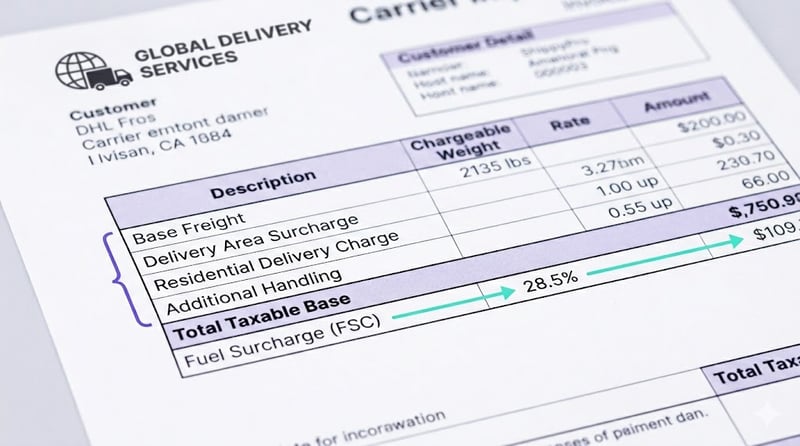
On most carrier invoices, the fuel surcharge appears as a separate line item labeled FSC, Fuel Surcharge, or Energy Surcharge. It is applied as a percentage of the taxable base, which includes base freight plus applicable accessorial fees, not just the freight charge alone. This is where most merchants significantly underestimate the real cost.
How fuel surcharges are calculated
The calculation follows a consistent structure across most carriers. A government-published fuel price index, tracking diesel or jet fuel, is monitored at a defined interval. A carrier-set percentage multiplier is then applied to your shipment's taxable base. The result is your fuel surcharge for that shipment.
The index mechanism
Carriers do not set fuel prices: they track published benchmarks. The most common reference indices are published by national energy agencies, including the U.S. Energy Information Administration (EIA) for domestic US shipments and equivalent bodies for European and international carriers. These indices update weekly and are publicly available at no cost. Checking them weekly takes minutes and tells you what your carrier's next surcharge update will look like before it hits your invoice.
The government benchmark updates, typically on a weekly cycle.
The carrier applies its multiplier to the index value and publishes a new surcharge rate on its own update cycle (weekly or monthly depending on service type).
The new surcharge percentage is applied automatically to every eligible shipment in that window. No notification is sent to you.
The surcharge percentage is applied to the full taxable base, including base freight plus applicable accessorial fees.
You receive a bill with the fuel surcharge as a separate line item, often weeks after the index moved.
Update cycles and lag times by service type
| Service Type | Index Used | Update Cycle | Typical Billing Lag |
|---|---|---|---|
| Domestic parcel | National diesel index | Weekly | 1-2 weeks |
| International air express | Jet fuel index | Monthly | 4-6 weeks |
| LTL freight | National diesel index | Weekly | 1-2 weeks |
| Ocean freight | Bunker fuel benchmark | Monthly | 4-8 weeks |
The surcharge stacking problem
Most merchants track the headline fuel surcharge rate. Far fewer understand that the surcharge is applied to a taxable base that already includes other accessorial fees, not just base freight. This compounding effect is called surcharge stacking, and it consistently causes merchants to underestimate their true fuel surcharge cost.
A 25% fuel surcharge on a 10 EUR base freight charge adds 2.50 EUR. But if that same shipment also carries a 3 EUR Delivery Area Surcharge, a 1.50 EUR Additional Handling fee, and a 2 EUR Residential Delivery charge, the fuel surcharge now applies to a 16.50 EUR taxable base, adding 4.13 EUR instead. That difference compounds across thousands of shipments per month. The only way to know your actual taxable base is to read your carrier contract and verify it against each invoice.
Common accessorial fees that typically form part of the taxable base
- Delivery Area Surcharge (DAS)
- Additional Handling
- Residential Delivery
- Address Correction
- Extended Area Surcharge
- Oversize / Over Maximum Limits
The exact composition is defined in your service agreement and varies by carrier. The practical implication: when a fuel surcharge rate increases by 5 percentage points, your effective additional cost per shipment can be substantially higher than a simple base-freight calculation would suggest. Using ShippyPro's Invoice Analysis is one of the most reliable ways to surface exactly which accessorial fees are in your taxable base on every invoice.
Free shipping thresholds erode margin silently, carrier overbilling goes undetected, cost models rest on outdated assumptions, and surcharge stacking multiplies unexpectedly.
Discrepancies are identified before they compound, contract compliance is verified on every invoice, cost models stay current, and carrier disputes are backed by documented evidence.
Why fuel surcharges are at historic highs in 2026
To understand current surcharge levels, a brief look at what happened in early 2026 is useful. The Strait of Hormuz, the maritime chokepoint through which roughly 20% of global oil flows, was effectively closed to commercial traffic in late February following regional military escalation. With no viable alternative route at comparable volume, energy markets responded immediately: Brent crude spiked from approximately $68 per barrel to over $120 in under two weeks. It was the fastest oil price surge in over 50 years.
As of April 2026, prices remain elevated at around $114 per barrel. Diesel and jet fuel benchmarks, which carrier surcharge tables track, have followed the same trajectory. The EU Weekly Oil Bulletin provides the European benchmark data carriers use to set surcharge tables for EU-bound shipments.
What this means for your shipping invoices right now
The surcharge increases already visible on invoices in April 2026 reflect fuel conditions from several weeks prior, due to the typical two-to-four week lag between index movement and billing. Carriers that use monthly update cycles with an additional index lag have not yet fully transmitted the March 2026 spike into their billing. A second wave of increases is structurally embedded in the pipeline and expected to appear on invoices in May and June.
The scale of moves already recorded is significant. International air import surcharges rose by as much as 13 percentage points between January and late March 2026. Some LTL freight surcharges reached levels above 46%. Emergency bunker surcharges appeared as new line items on ocean freight invoices across global carriers. This is not a temporary anomaly: it is a sustained elevated baseline with further upward pressure still to transmit through the billing cycle.
Why e-commerce businesses are particularly exposed
For e-commerce operators, the 2026 environment is unusually difficult because cost pressure is hitting both sides of the commercial model simultaneously.
Outbound: last-mile and express delivery
Last-mile and express delivery surcharges have increased across all service categories. If you offer free shipping (a threshold built on specific cost assumptions at the time of pricing), the surcharge increases since January 2026 have very likely invalidated the economics behind that number. Jet fuel benchmarks used to price air express services have more than doubled since late 2025. Any free shipping model designed before February 2026 is operating on a cost baseline that no longer reflects market conditions.
For merchants using a multi-carrier shipping platform, the ability to switch volume between carriers when one applies a particularly steep surcharge increase is a practical lever. Rate comparison at the point of label creation is one of the most direct ways to reduce per-shipment exposure.
Inbound: ocean freight and imports
Operators importing goods from Asia face a separate set of compounding costs: Asia-Europe spot container rates have increased over 150% from pre-crisis baselines, new emergency surcharge line items have appeared on ocean freight invoices, and rerouting via the Cape of Good Hope adds 10-14 days of transit time per voyage, increasing working capital requirements on top of the rate increases themselves.
Recalibrating your cost models
Any cost model, free shipping threshold, or margin target built before February 2026 is using assumptions that no longer reflect market conditions. Recalculate using current surcharge levels as inputs. If your free shipping threshold was set when fuel surcharges were 15 points lower, that threshold needs to be reviewed now. Tools like ShippyPro's rate optimiser can help you identify which carrier and service combination produces the best landed cost under current surcharge conditions.
How to monitor and control fuel surcharge costs
Monitoring fuel surcharges does not require complex tools to start. It requires consistency and a clear process. Here are the steps that make the practical difference.
Track the upstream fuel indices directly
The fuel benchmarks carriers use are publicly available. The EIA publishes weekly diesel and jet fuel prices at no cost. European operators can reference the EU Oil Bulletin for equivalent European data. Cross-reference what you see on indices against your carrier's published surcharge table for the same period. Any divergence is the first signal of a billing discrepancy.
Audit every invoice, not just a sample
Sampling methodologies miss systematic surcharge misapplication. In a high-volatility environment where rates update weekly, the only defensible approach is full invoice auditing on every billing cycle. For each shipment, verify the surcharge rate applied against the carrier's published table for that period, and confirm that the taxable base matches your contract terms. ShippyPro's Invoice Analysis automates this process, running the comparison in one to two minutes per invoice upload.
Keep your carrier contract terms in one place
Many shipping teams discover that their carrier agreements are split across emails, PDFs, and account portals, with the contract governing their current invoices dating back 18 or 24 months. Maintain a single document listing the surcharge methodology, taxable base definition, and update cycle for each carrier you use. This is the reference point for every dispute.
When you find a billing discrepancy, document it with the carrier's own published surcharge table for that billing period. Carriers cannot dispute their own published rates. A report showing the billed amount alongside the contracted or published rate is the fastest path to a credit. Most carriers process verifiable discrepancies within one to two billing cycles.
Invoice monitoring checklist
| Task | Frequency | What to verify |
|---|---|---|
| Check fuel index | Weekly | EIA diesel/jet fuel benchmark; carrier surcharge table |
| Audit carrier invoices | Every billing cycle | Surcharge rate vs. published table; taxable base vs. contract |
| Review carrier contract | Quarterly | Surcharge methodology; taxable base definition; multiplier |
| Update cost models | Monthly | Free shipping thresholds; margin targets; landed cost estimates |
| Dispute overbilling | As needed | Export discrepancy report; submit with contract reference |
How ShippyPro Invoice Analysis helps
Manually cross-referencing every invoice line against carrier rate tables and contract terms is workable at low shipment volumes. At scale, it is not. ShippyPro's Invoice Analysis module automates the process. Upload your carrier invoice in CSV or XLS format and the tool completes the analysis in one to two minutes.
Two types of analysis in one upload
Each invoice upload runs two analyses simultaneously. The first is a comprehensive cost breakdown: freight cost, fuel surcharge, extra charges (remote areas, address correction, special handling), duties and taxes, VAT, and any discounts applied by the carrier. Every line item is surfaced and quantified, including surcharges that are easy to miss when reviewing a raw invoice file.
The second is a discrepancy analysis: a comparison between what the carrier billed and the shipping cost data recorded in your ShippyPro shipping platform. It identifies price differences, weight and volume discrepancies between carrier records and your declared shipment data, and duplicate billing where the same tracking code appears more than once on a single invoice.
Acting on the results
Once the analysis is complete, you can export three report types: the full shipment list, the discrepancy analysis, and detailed drill-downs by cost category. These exports are the documentation you need to raise a dispute with your carrier. You can also use ShippyPro's track and trace data alongside the invoice analysis to cross-reference delivery confirmation against billing dates, which is useful when disputing late-delivery refund claims.
Supported carriers and getting started
Invoice Analysis currently supports DHL Express, UPS, BRT, GLS Italy, and FedEx, with more carriers being added. Your first three invoice analyses are free, so you can verify the tool against real invoices before committing to a subscription. Full details on supported formats and pricing are in the Invoice Analysis Help Center article.
In an environment where surcharge rates are moving weekly and billing complexity is at a historic high, having this level of automated visibility is the difference between reacting to overbilling months later and catching it within the current billing cycle. Combined with AI-powered shipping automation to route volume toward lower-surcharge carriers, and a returns management process that accounts for current surcharge levels, you have a complete picture of true shipping costs across every order.
Invoice Analysis
Upload your carrier invoice and get a full breakdown of freight costs, surcharges, and discrepancies vs. your contracted rates in under two minutes.
Explore Invoice Analysis →Rate Optimiser
Compare live carrier rates at the point of label creation to ensure every shipment goes out on the best available rate under current surcharge conditions.
See the Optimiser →Shipping Platform
Manage all your carriers, orders, and labels from one place. Switch volume between carriers as surcharge conditions change without renegotiating contracts.
See the Platform →AI Shipping Automation
Automate carrier selection rules so your cheapest eligible carrier wins every shipment, factoring in current surcharge levels automatically.
Learn More →Easy Returns
Manage return shipping costs with a clear process that accounts for current carrier surcharge levels on both outbound and return labels.
Learn More →ShippyPro Resources
Guides, tools, and documentation to help you manage shipping costs, carrier integrations, and logistics operations at scale.
Visit Resources →What is a fuel surcharge in shipping?
A fuel surcharge (FSC) is a variable fee carriers add to your shipping invoice on top of the base freight rate. It adjusts automatically as fuel prices change, tracking a published government index. It is applied as a percentage of your taxable base, which includes base freight plus applicable accessorial fees, not just the base rate alone.
How often do carrier fuel surcharges change?
It depends on the carrier and service type. Domestic parcel carriers typically update weekly; international air and ocean carriers update monthly. In volatile market conditions like 2026, some carriers have shifted to more frequent updates. There is no contractual obligation for carriers to notify you of each change individually, which is why proactive monitoring matters.
Can I negotiate fuel surcharges with my carrier?
The surcharge rate itself is tied to a published index and is not negotiable. However, the multiplier applied to that index, the taxable base definition, and the update cycle are all commercial terms in your service agreement and can be negotiated at contract renewal. Many shippers do not realise this until they are already at the table.
What is surcharge stacking?
Surcharge stacking is the effect of a fuel surcharge being calculated on a taxable base that already includes other accessorial fees, not just base freight. This means the fuel surcharge compounds on top of Delivery Area Surcharges, Additional Handling, Residential Delivery charges, and others, making the effective cost higher than the headline percentage suggests.
How do I dispute a fuel surcharge overbilling with my carrier?
Start with documentation. Compare the surcharge rate your carrier applied against their own published table for the billing period in question. If there is a discrepancy, prepare a report showing the billed amount, the published or contracted rate, and the difference per shipment. Submit this to your carrier's billing team with your contract reference number. Most carriers process credits for verifiable discrepancies within one to two billing cycles. ShippyPro's Invoice Analysis generates this report automatically, covering price differences, weight and volume discrepancies, and duplicate billing, exportable directly from Analytics > Invoice Analysis in your account.
Stop overpaying on carrier fuel surcharges
ShippyPro's Invoice Analysis shows you exactly what you were billed versus what your contract requires, so you can identify discrepancies and get your money back.
Start for free →
The Product Team at ShippyPro is dedicated to building innovative solutions that empower businesses to simplify their shipping operations. By combining customer research with cutting-edge technology, we design features that enhance efficiency, reduce effort, and boost logistics flexibility.